Skin Science · 8 min read
Why Perimenopausal and Menopausal Skin Often Responds Better to Botanical Oils
The biological case for botanical oils in perimenopause and menopause. Why cold-pressed plant oils match what mature skin has lost, and what that means for results.
Three things to know
What Menopausal Skin Is Missing.
What Cold-Pressed Botanical Oils Actually Contain.
Why This Match Matters.
Most body care formulated for mature skin still relies on the same basic approach used for skin of any age: water-based lotions with synthetic emollients, occlusives like petrolatum or mineral oil, and humectants designed to attract moisture. These formulations work for most skin types most of the time. They are stable, inexpensive, and easy to manufacture at scale.
But many women in perimenopause and menopause notice the same thing. The familiar lotions stop performing the way they used to. Even rich, expensive formulations can leave the skin tight an hour after application. Something has shifted, and the products that once delivered are no longer enough.
Botanical oils, by contrast, often outperform conventional formulations on menopausal skin. This is not because they are natural, or because plants are inherently superior. It is because of a specific biological match between what menopausal skin has lost and what cold-pressed plant oils deliver.
Here is the actual case for botanical oils in this phase of skin.
What Menopausal Skin Is Missing
Estrogen declines in perimenopause and menopause. With it, the skin loses several specific things:
- Ceramides and cholesterol that form the lipid mortar between skin cells
- Free fatty acids, especially linoleic acid, that the skin uses to produce more ceramides
- Sebum, which provides a thin lipid film on the skin's surface
- Hyaluronic acid, which holds water in the dermis
- Natural antioxidants, including vitamin E, which protect lipids from oxidation
The visible and felt consequences (dryness, sensitivity, crepiness, slower healing) are not vague aging. They are specific deficits in specific molecules.
Effective skincare for this phase needs to replace what is missing. Not symbolically, but in chemical terms. The compounds the skin has lost need to arrive at the barrier in forms it can use.
This is where botanical oils have a structural advantage over most conventional formulations.
What Cold-Pressed Botanical Oils Actually Contain
Cold-pressed plant oils are not simple emollients. They are complex mixtures of fatty acids, antioxidants, and supporting compounds that the plant produced for its own seed protection.
A well-chosen botanical oil typically delivers:
- Linoleic acid (omega-6), the building block of barrier ceramides
- Oleic acid (omega-9), a softening and conditioning fatty acid
- Alpha-linolenic acid (omega-3), which supports calmness and reduces inflammation
- Natural vitamin E (tocopherols), the lipid-soluble antioxidant that protects skin lipids
- Phytosterols, plant compounds structurally similar to cholesterol
- Squalene, particularly in some oils like olive and argan
- Carotenoids and polyphenols, additional antioxidants
These are essentially the same categories of compounds that healthy skin produces for itself. The match is not metaphorical. It is molecular.
Why This Match Matters
The skin's barrier is built from specific lipids in specific proportions. Ceramides, cholesterol, and free fatty acids in roughly equal parts. When this composition is disrupted, the barrier loses function.
Topical compounds that match this composition can integrate into the barrier and support it. Compounds that do not match can sit on the surface, provide temporary occlusion, and feel pleasant, but they do not become part of the structure.
This is the key distinction.
Petrolatum and mineral oil are occlusives. They form a film on the skin's surface that slows water loss. They do not become part of the barrier itself. They do not deliver fatty acids the skin can use to rebuild. They are useful for short-term protection, particularly on damaged skin, but they do not address underlying lipid depletion.
Silicones create a smooth feel and reduce water loss similarly. Like occlusives, they sit on top of the skin rather than integrating with it.
Synthetic emollients vary widely. Some are well-tolerated and skin-compatible. Many are designed primarily for stability and texture in the formulation rather than for biological match with skin lipids.
Cold-pressed botanical oils deliver fatty acids in forms the skin recognizes and incorporates. They support the barrier rather than substituting for it.
For young, well-functioning skin, this distinction matters less. The barrier is intact and producing its own lipids. Occlusion and surface conditioning are usually enough.
For menopausal skin, which has lost the capacity to produce these lipids in sufficient quantity, the distinction matters considerably. The barrier needs raw materials, not just a film over the top.
The Linoleic Acid Question Specifically
Of all the fatty acids in this conversation, linoleic acid deserves the most attention.
It is an essential fatty acid, meaning the body cannot produce it. It must come from diet or topical application. In the skin, it is the building block of acylceramides, a specific family of ceramides that are central to barrier integrity.
Mature skin tends to have a lower ratio of linoleic acid to oleic acid than younger skin. This shift is associated with a less robust barrier, lower ceramide synthesis, and more reactive skin. It is one of the underlying biological changes behind menopausal dryness and sensitivity.
Topical linoleic acid can correct this shift. Skin that receives consistent linoleic acid through the right oils begins producing better ceramides, retaining more water, and behaving more like a healthy barrier should.
A few botanical oils are particularly rich in linoleic acid:
- Sunflower seed oil (around 60% linoleic acid)
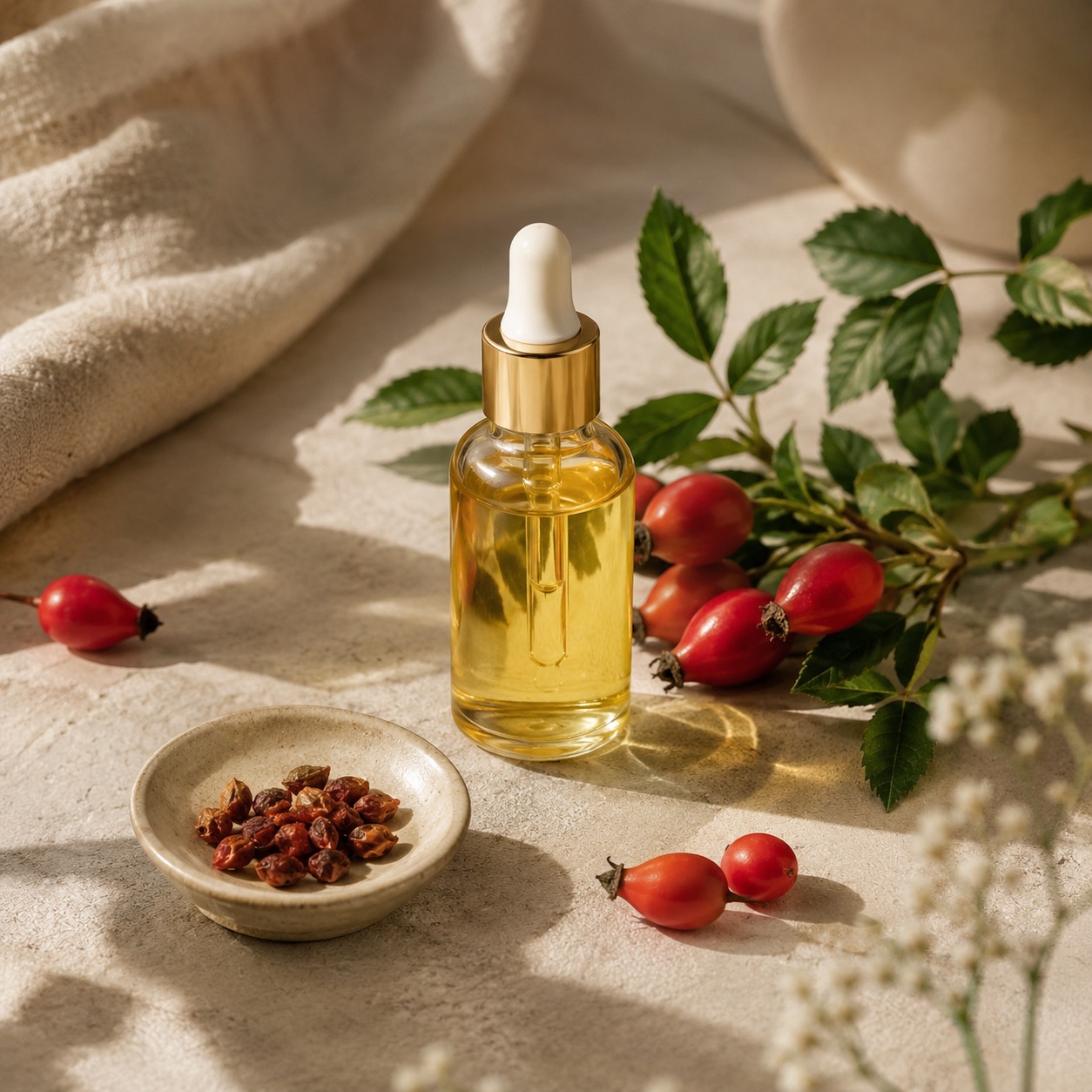
- Rosehip seed oil (around 40-55%)
- Grapeseed oil (around 60-70%)
- Safflower oil (around 70%)
Cold-pressed sources of these oils deliver linoleic acid in a form the skin recognizes and uses. Most conventional lotions, even good ones, do not deliver linoleic acid in meaningful concentrations.
Why Blends Outperform Single Oils
No single oil delivers the full fatty acid profile that menopausal skin needs.
Linoleic acid is essential for ceramide production, but a barrier built only on linoleic acid would be incomplete. Oleic acid contributes softness and helps other compounds penetrate. Alpha-linolenic acid supports calmness. Phytosterols add structural support. Vitamin E protects the polyunsaturated fatty acids in the blend from oxidation, which is important because oils rich in linoleic acid are also more prone to oxidation when used alone.
A thoughtful blend balances:
- High-linoleic oils (sunflower, rosehip) for barrier support
- Oleic-rich oils (sweet almond, argan) for softening and stability
- Wax esters (jojoba) that mimic skin sebum
- Omega-3-rich oils (raspberry seed) for calmness
- Mineral-rich oils (pumpkin seed) for additional antioxidant content
This is part of why a well-formulated botanical oil blend tends to work better than any single oil applied alone, regardless of how good that single oil is.
What Conventional Lotions Cannot Quite Do
It is worth being specific about what is and is not happening with most water-based body lotions.
A typical body lotion is 70-90% water. The water is the delivery vehicle. Humectants like glycerin attract moisture. A small percentage of emollients, often a mix of synthetic compounds and a token amount of plant oil, provides surface softening. Preservatives and stabilizers hold the emulsion together.
On well-functioning skin, this delivers a pleasant temporary effect. The water absorbs, the humectants pull in additional moisture from the air, the surface feels softer.
On menopausal skin with a depleted barrier, the same formulation behaves differently. The water evaporates faster than the barrier can hold it. The humectants, in dry environments, can pull moisture upward from the deeper skin layers rather than drawing it in from the air. The oil content is usually too low to genuinely replenish what the barrier has lost.
The lotion is doing its job. The job is just not enough for what menopausal skin actually needs.
A botanical oil, by contrast, delivers concentrated lipids without a water phase that evaporates. Applied to damp skin after a shower, it locks in the moisture already on the skin while supplying the fatty acids the barrier is missing. Two jobs at once, both of them well-matched to what menopausal skin is asking for.
The Sensory Argument
There is a practical reason botanical oils sometimes get dismissed by women who have not used a well-formulated one. Older or poorly chosen oils can feel heavy, greasy, or slow to absorb. Mineral oils and some synthetic oils in particular have given the entire category an outdated reputation.
A well-formulated cold-pressed plant oil blend feels different. It absorbs quickly. It leaves skin soft rather than greasy. There is no heavy residue an hour later, just supple, comfortable skin that stays that way.
The sensory experience matters because it affects whether the product gets used consistently. Consistent use over weeks is what produces the actual change. A product that feels uncomfortable, however good its formulation, will not get applied long enough to deliver results.
What the Research Supports
The evidence base for botanical oils in skincare has grown considerably in recent decades:
- Multiple studies confirm that topical linoleic acid supports barrier repair and ceramide synthesis
- Oils rich in essential fatty acids reduce transepidermal water loss when applied consistently
- Cold-pressed plant oils preserve antioxidants that refined or heat-extracted versions lose
- Natural vitamin E in plant oils protects skin lipids from oxidation
- Several oils (rosehip, raspberry seed, pumpkin seed) have documented benefits for healing and skin tone
This is not the same as saying every botanical oil is suitable for every skin type. Quality, sourcing, extraction method, and formulation all matter. A poorly chosen oil or a poorly stored one will not deliver these benefits.
But the underlying biology is sound. Botanical oils, well chosen and well formulated, do something for menopausal skin that conventional formulations cannot quite match.
The Baya Approach
Baya was built around this specific insight. Menopausal skin needs lipid replenishment in forms the barrier can recognize and use. The blend combines sunflower, sweet almond, jojoba, argan, rosehip, raspberry, and pumpkin seed oils to deliver a full fatty acid profile, natural antioxidant content, and the stability that comes from balanced formulation.
It is not a competing version of body lotion. It is a different category of product, designed for a phase of skin that the lotion category does not fully serve.
The Bottom Line
Botanical oils often work better on menopausal skin because of biological match. Cold-pressed plant oils deliver the same categories of compounds the skin produces for itself, in forms the barrier can integrate and use. Conventional water-based lotions and synthetic emollients can soften the surface, but they do not replace the lipids that estrogen decline has depleted.
The case for botanical oils in this phase is not philosophical. It is structural. Skin that has lost specific compounds responds to formulations that deliver those specific compounds. Botanical oils, well chosen and applied consistently, are one of the most direct ways to do this.
The improvement when women switch is often striking, and usually clear within a few weeks.
Frequently asked questions
Menopausal skin has lost specific lipids that botanical oils deliver in forms the barrier can use directly. Linoleic acid, oleic acid, vitamin E, and supporting fatty acids in cold-pressed plant oils match what the skin produces for itself, which is a structural advantage over synthetic emollients and water-based lotions.
Not because they are natural. They are often better for menopausal skin specifically because their fatty acid composition matches what the depleted barrier needs. For younger or well-functioning skin, the difference is smaller. For mature skin missing specific lipids, the difference can be significant.
A blend tends to work better than any single oil. Look for combinations of sunflower (high in linoleic acid), sweet almond, jojoba, argan, rosehip, raspberry seed, and pumpkin seed oils. Cold-pressed and unrefined preserves the antioxidants that give the oils their value.
Most well-chosen plant oils are non-comedogenic. Sunflower, jojoba, argan, rosehip, raspberry seed, and pumpkin seed oils are particularly well-tolerated. Issues usually arise from oxidized or low-quality oils, or from oils that are simply too rich for facial skin (which body oils, on the body, generally are not).
Yes, and for many women in perimenopause and menopause it produces better results. Applied to damp skin after a warm shower, a well-formulated body oil delivers lipids more effectively than a water-based lotion and tends to maintain comfort for longer.
Most women notice softer, less reactive skin within two to four weeks of consistent use. More substantial changes in texture and resilience usually appear between four and twelve weeks.
More from The Baya Journal