
Skin Science · 7 min read
Why Perimenopausal and Menopausal Skin Need Barrier-Focused Care
Why barrier-focused care is the right framework for menopausal skin, what it means in practice, and why it addresses more symptoms than treating each one separately.
Three things to know
What Barrier-Focused Care Actually Means.
Why This Matters More in Menopause.
What Compromises the Barrier in Midlife.
Most skincare aimed at women over 45 is still organized around the wrong question.
The dominant framework asks: what do I add to fix this problem? Retinol for fine lines. Vitamin C for dullness. Acid for texture. Peptides for firmness. Each symptom gets its own product, its own active ingredient, its own slot in the routine. The skincare cabinet expands. The skin, in many cases, gets more reactive rather than less.
For menopausal skin specifically, this approach is upside down. The right question is not what to add. It is what to protect, support, and restore. Barrier-focused care reframes the whole routine around the underlying structure that makes everything else possible, and once you understand why, the rest of the routine simplifies considerably.
This is the case for a different approach.
What Barrier-Focused Care Actually Means
The skin's barrier is its outermost functional layer. Built from skin cells held together by a mortar of ceramides, cholesterol, and fatty acids, it does the essential work of keeping water in the body and irritants out. When it functions well, the skin feels comfortable, looks even, and tolerates a wide range of inputs without reaction.
Barrier-focused care is a routine built around supporting this structure. The goal is not to treat each symptom in isolation. It is to maintain the barrier well enough that most symptoms either resolve on their own or become much smaller.
In practical terms, this means:
- Choosing gentle cleansers that do not strip lipids
- Avoiding products and active ingredients that compromise barrier function
- Replenishing the lipids the barrier depends on
- Reducing chronic inflammation that erodes the barrier over time
- Using actives only when the barrier can tolerate them
This is a foundational approach, not a maintenance one. Barrier health is what makes everything else in skincare possible.
Why This Matters More in Menopause
For younger skin, barrier function is largely automatic. The skin produces enough lipids to maintain itself. Damage from harsh products or hot water repairs quickly. The cost of treating symptoms aggressively is low because the barrier can recover.
For menopausal skin, the math changes.
Estrogen decline reduces lipid production. Ceramides, cholesterol, and the fatty acids that hold the barrier together are all produced in smaller quantities. Sebum, which provides surface protection, decreases. The skin's repair speed slows. Damage that the barrier could once absorb and recover from now accumulates.
This means:
- A barrier that is already running at a deficit cannot afford to be further compromised
- Aggressive actives produce more side effects relative to their benefits
- Routines that worked at 35 often make menopausal skin worse rather than better
- Recovery from over-treatment takes much longer
Barrier-focused care is not just a preference for gentleness. It is a recognition that the resources the skin has to work with are smaller, and that the routine has to operate within that reality.
What Compromises the Barrier in Midlife
Many of the things that compromise menopausal skin barriers are routine practices most women do not question:
Hot showers dissolve lipids faster than the skin can replace them.
Foaming, sulfate-based cleansers are formulated to strip oils, which is exactly what the barrier needs to keep.
Frequent or strong exfoliation removes the stratum corneum faster than menopausal skin can rebuild it.
Retinoids at high concentrations thin the barrier as part of their mechanism.
Acid toners and treatments used daily, especially in combination with other actives.
Fragranced products, both synthetic and essential-oil based, on already reactive skin.
Aggressive cleansing tools like sonic brushes and exfoliating cloths.
Low humidity environments, including air conditioning, dry winter air, and heated indoor spaces.
None of these are inherently bad. Most are fine for younger skin. The issue is cumulative: when several of them happen daily on skin that is already producing fewer lipids, the deficit deepens.
Barrier-focused care identifies and reduces these inputs, even modestly. The improvement often comes as much from what is stopped as from what is added.
What a Barrier-Focused Routine Looks Like
A well-designed barrier-focused routine for menopausal skin is shorter and simpler than most women are used to.
Morning:
- Splash water rinse or gentle cleanser (no foaming sulfates)
- Lightweight serum if desired (vitamin C in a stable form, for example)
- Lipid-rich moisturiser or facial oil
- Sunscreen, every day
Evening:
- Gentle cleanser to remove sunscreen and the day
- Active ingredient if and only if the barrier is calm (low-strength retinoid, for example, two or three nights a week)
- Lipid-rich oil to support overnight repair
Body:
- Warm rather than hot showers
- Gentle, low-foaming body wash
- Lipid-rich body oil applied to damp skin
This is intentionally minimal. Most women's routines have far more steps than this. The reduction is not about doing less work. It is about removing inputs that the barrier cannot afford and replacing them with inputs that genuinely support it.
What Replenishment Means in Practice
Barrier replenishment is not metaphorical. The barrier is built from specific compounds, and replenishment means delivering those compounds in forms the skin can use.
The most important categories:
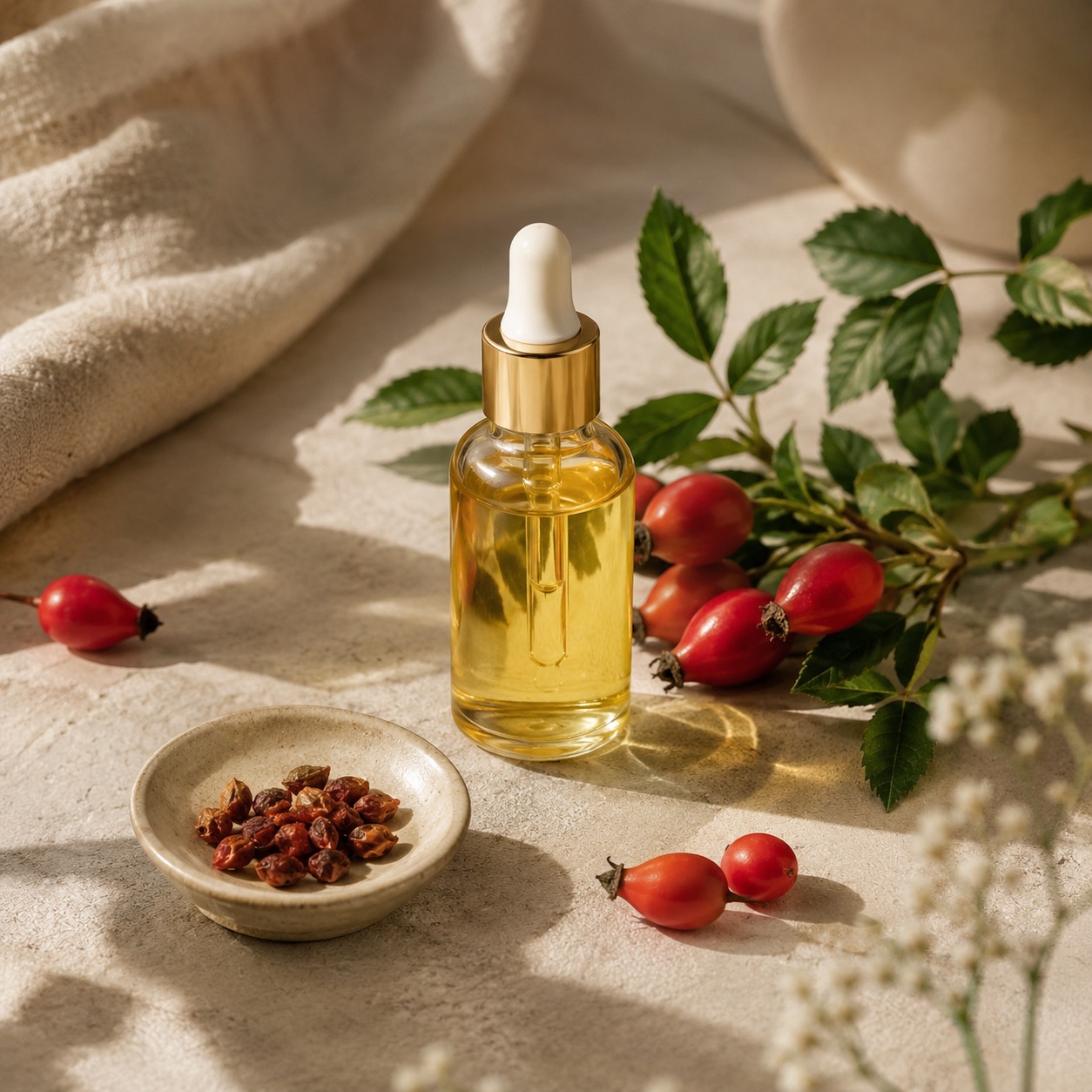
Fatty acids, especially linoleic acid, which is the building block of the ceramides that hold the barrier together. Sunflower, rosehip, and grapeseed oils are particularly rich in linoleic acid.
Oleic acid, which softens and conditions. Sweet almond, argan, and olive oils contribute oleic acid.
Ceramide-supporting compounds, including phytosterols and plant-derived squalene found in cold-pressed oils.
Natural vitamin E, which protects the polyunsaturated fatty acids in the formulation and in the skin from oxidation.
Omega-3 fatty acids, which support calmness and reduce inflammation. Raspberry seed oil is a useful source.
Most water-based lotions, even good ones, do not deliver these compounds in concentrations meaningful enough to replenish a depleted barrier. A well-formulated body or facial oil does, because the entire product is composed of these compounds rather than 80% water.
This is why barrier-focused care for menopausal skin tends to involve oils more than lotions. The category matches the need.
How Barrier-Focused Care Addresses Multiple Symptoms
One of the most useful properties of barrier-focused care is that a single approach addresses many different symptoms at once.
- Dryness improves because the barrier holds water better when its lipids are replenished
- Sensitivity decreases because a functional barrier filters out the irritants that were previously reaching deeper skin
- Itching subsides because barrier-depleted skin is the primary driver of the nighttime itch many women experience
- Crepiness softens because well-hydrated skin reflects light more evenly
- Reactivity lessens because chronic low-grade inflammation drops when the barrier is intact
- Slower healing improves because a healthier barrier supports the skin's repair processes
This is why women who switch to barrier-focused care often describe several improvements at once rather than just one. The mechanism is foundational, and addressing it produces ripple effects across multiple symptoms.
It also means a smaller, well-chosen routine can replace a much larger one.
What Barrier-Focused Care Is Not
A few clarifications are worth making.
It is not anti-active. Retinoids, vitamin C, and other actives can have a role. The point is that the barrier must be supported first, and actives should be added only when the barrier can tolerate them. The order matters.
It is not about doing nothing. Barrier-focused care is active. It involves consistent daily application, careful product selection, and deliberate avoidance of barrier-compromising inputs.
It is not anti-science. The biology of barrier function is one of the most well-established areas of dermatology. This approach is grounded in established science, not folk skincare wisdom.
It is not the same as "natural" skincare. Some natural products compromise the barrier (essential oils at high concentrations, for example). Some synthetic ingredients support it. The framework is biological, not philosophical.
How Long It Takes
Barrier-focused care is not dramatic. Improvements compound over weeks rather than producing instant results.
Most women notice:
- Within one week: less tightness after washing, fewer small reactions
- Within two to four weeks: softer skin, less reactivity, more comfortable feel
- Within four to twelve weeks: improved texture, fewer flare-ups, more even tone, more resilience to triggers that previously caused problems
The pace is slower than what aggressive actives produce in the short term. But the results are more stable, and they tend to hold rather than requiring constant intervention to maintain.
This is the genuine advantage of foundational care. It does not need to be escalated.
The Baya Approach
Baya was built around barrier-focused care for this specific phase of skin. A lipid-rich body oil formulated to deliver the fatty acids, antioxidants, and supporting compounds that menopausal skin has lost, applied as part of a simple, consistent routine that respects what the barrier can handle.
The blend (sunflower, sweet almond, jojoba, argan, rosehip, raspberry, and pumpkin seed oils) was chosen specifically for biological compatibility with mature skin. The simplicity of the application (damp skin, daily, after a warm shower) was chosen because complexity does not improve results in this approach.
The goal is foundational support, not a separate product for every symptom.
The Bottom Line
Barrier-focused care is the right framework for perimenopausal and menopausal skin because it addresses the underlying mechanism rather than chasing each symptom separately.
The barrier has lost lipids that estrogen used to support. Without those lipids, the skin is more reactive, drier, slower to heal, and more vulnerable to inputs that were previously tolerated. No amount of additional actives or treatments fully compensates for this underlying deficit.
Replenishing the barrier with lipid-rich oils, reducing the inputs that compromise it, and simplifying the routine to what the skin can actually use produces broad improvement across multiple symptoms at once. The pace is steady rather than dramatic, but the results hold.
For most women in this phase, the better question is not what to add to the routine. It is what to support, what to remove, and what to consistently replenish.
Frequently asked questions
Barrier-focused skincare is a routine built around supporting the skin's outermost protective layer. It prioritizes gentle cleansing, lipid replenishment, and avoiding ingredients that compromise barrier function, rather than treating each symptom with a separate active.
Estrogen decline reduces the skin's ability to produce the lipids that hold the barrier together. Routines that worked at 35 often make menopausal skin worse rather than better because they assume an intact barrier the skin no longer has. A barrier-focused approach addresses the actual deficit.
Yes, but carefully. Retinoids should be added only when the barrier is calm and tolerating them, used at lower concentrations, and applied less frequently than is typical. The barrier comes first; actives come second.
Gentle cleansers without sulfates, lipid-rich oils or moisturisers containing linoleic acid and natural vitamin E, fragrance-considered formulas, and daily sunscreen. The list of what to use is usually shorter than the list of what to stop using.
Signs include tightness after washing, sensitivity to products that used to be fine, persistent dryness despite consistent moisturising, redness or stinging from familiar ingredients, and itching, especially at night.
Most women notice improvement within two to four weeks of consistent barrier-focused care. More substantial changes in resilience, texture, and reactivity usually appear between four and twelve weeks. Skin that has been compromised for longer takes proportionally longer to recover.
More from The Baya Journal