
Skin Science · 7 min read
Why Lipid Replenishment Matters More Than Exfoliation
For menopausal skin, lipid replenishment addresses the real cause of dryness and dullness. Why the priority shifts from exfoliation to replenishment after 45.
Three things to know
How Exfoliation Became the Default.
What Exfoliation Actually Does.
What Menopausal Skin Cannot Afford to Lose.
Walk through any beauty hall and the dominant message is clear. Smoother skin is better skin. Cleaner skin is brighter skin. The path to a fresh complexion runs through acids, scrubs, peels, and resurfacing treatments. The implicit logic is that something is sitting on top of the skin, and the work of skincare is to take it off.
For decades, this has been the prevailing philosophy. For many skin types and many phases of life, it has held up reasonably well.
For menopausal skin, it tends to do more harm than good.
The shift worth understanding is this: as the skin ages and estrogen declines, the question is no longer what can I remove but what can I replenish. The barrier has lost things it needs. The lipids that once held it together have thinned. Exfoliation, however well-intended, cannot return what has been depleted. Only replenishment can.
How Exfoliation Became the Default
It is worth recognizing why exfoliation became so culturally dominant.
The results are fast and visible. A glycolic peel produces noticeably smoother skin within hours. A scrub leaves skin feeling clean and polished in real time. Retinol delivers texture changes over weeks that are easy to photograph. In a category that rewards immediate, demonstrable change, exfoliation has been an obvious winner.
There are also genuine clinical contexts in which exfoliation does meaningful work. Acne, sun damage, hyperkeratosis, and certain pigmentation patterns can all benefit from controlled exfoliation. The science is real. The mistake is not the technique itself.
The mistake is the generalization. The assumption that what works for an oily 28-year-old with congested skin must also be the right priority for a 54-year-old whose barrier is already thin and whose skin has lost its lipid integrity.
These are different skins. They have different needs.
What Exfoliation Actually Does
The stratum corneum, the outermost layer of skin, looks like dead tissue under a microscope. For most of the twentieth century, it was treated that way. Remove it, the reasoning went, and you reveal fresher skin underneath.
The understanding has shifted considerably since then. The stratum corneum is now understood as biologically active and metabolically essential. It is the skin's primary barrier against water loss and external irritants. It contains the lipids, ceramides, fatty acids, and natural moisturizing factors that determine how comfortable, hydrated, and resilient the skin actually is.
Exfoliation, whether mechanical or chemical, accelerates the removal of this layer.
On younger, well-functioning skin, this is often fine. The barrier rebuilds quickly. The lipids replenish. The slight short-term cost is offset by the apparent gain in smoothness and clarity.
On menopausal skin, the math changes. The barrier rebuilds more slowly. The lipid mortar between cells is already thinner. Removing layers of the stratum corneum that the skin cannot easily replace pushes the barrier further into deficit rather than returning it to baseline.
This is the part that most exfoliation routines designed for younger skin do not account for.
What Menopausal Skin Cannot Afford to Lose
When estrogen declines, several things shift at once in the skin.
Lipid production slows. Ceramide levels fall. Cell turnover decelerates, which means the stratum corneum that does exist took longer to build than it would have in younger years. Transepidermal water loss increases. The skin's recovery from any insult, sun, friction, harsh products, slows.
In this context, the stratum corneum is not surplus material to be cleared away. It is the thinning frontier of an already strained barrier.
Aggressive exfoliation on this skin produces a predictable pattern. The skin feels temporarily smoother. Within days or weeks, it begins to feel tighter, drier, and more reactive. Products that were once tolerated now sting. The skin seems to take longer to feel comfortable after washing. The familiar response is to apply more product, often more exfoliation, in pursuit of the smoothness that has somehow drifted further away.
The underlying problem is that what looked like a routine is actually a slow erosion.
Why Dullness Is Often Lipid Loss, Not Buildup
The instinct that dull skin needs to be exfoliated is so ingrained that it is worth examining carefully.
Dullness in younger skin is sometimes genuinely about buildup, congestion, or uneven turnover. Gentle exfoliation can help.
Dullness in menopausal skin almost always has a different cause. It reflects a barrier that is no longer reflecting light evenly because it is dehydrated, thinner, and missing the lipid film that gives healthy skin its quiet luminosity. The skin is not dull because something is on top of it. It is dull because something is missing from inside it.
Lipid replenishment restores luminosity through a completely different mechanism than exfoliation does. It does not strip the surface to reveal something underneath. It replenishes the very layer that creates the soft, even light reflection of comfortable skin.
The visual difference, once you know what to look for, is recognizable. Exfoliated skin has a thinner, taut kind of brightness. Replenished skin has a fuller, suppler one. Both can look good in photographs. Only the second feels good in the long run.
The Inverse Approach
Lipid replenishment runs on the opposite logic of exfoliation.
Exfoliation asks: what can I remove to make this better? Replenishment asks: what can I add back to make this better?
For menopausal skin, the second question is closer to the actual biology. What has been lost is specific: linoleic acid, oleic acid, ceramide precursors, plant-derived squalene, vitamin E, fatty acids that integrate into the depleted barrier and help restore its structure. These are not exotic compounds. They are the materials the barrier was already built from, before estrogen decline reduced their availability.
Plant oils with carefully chosen fatty acid profiles deliver these materials directly. Applied consistently to damp skin, they slot into the gaps in the barrier and begin the slow work of rebuilding it. The effect is not immediate in the way a peel is immediate. It accumulates. Two weeks in, the skin feels less reactive. Six weeks in, the texture has softened. Three months in, what felt fragile feels comfortable again.
This is the trajectory that menopausal skin actually responds to.
Where Exfoliation Still Fits
None of this is an argument against exfoliation in principle. The argument is about priority and proportion.
Once the barrier is restored, gentle exfoliation can have a supporting role. The keyword is gentle. Mild enzymatic exfoliants, low-strength lactic acid, or soft physical methods like a soft cloth in the shower can occasionally lift surface cells without disturbing the deeper barrier. Used sparingly, perhaps once a week or less for body skin, they can support rather than undermine the broader work of replenishment.
The sequence matters too. Lipid replenishment first. Exfoliation second, if at all. The skin should feel comfortable, supple, and resilient before any exfoliation is layered on. If exfoliation is producing tightness, redness, or stinging, that is the barrier reporting that it is not yet in a state to tolerate it.
This is the opposite of how most exfoliation routines are structured, which tend to start with the acid and then chase the resulting dryness with moisturizer.
What Healthy Menopausal Skin Actually Feels Like
There is a particular sensory quality to skin that has been properly replenished.
It is supple rather than taut. It does not feel tight after washing. It does not sting in response to cool air or to a familiar product. The forearms feel soft to the inside of the hand. The chest feels plump rather than papery. The shins feel comfortable under clothing in winter.
Over-exfoliated skin feels different. It can look smooth in a certain light but feels thin to the touch. It is reactive. It seems to age forward rather than backward, despite the routine that was meant to keep it youthful.
The sensory signal is reliable, and it tends to be more honest than the visual one.
A Quieter Skincare Logic
Most skincare aimed at women over 45 still leans heavily on the language of removal. Resurfacing. Renewing. Stripping away the old to reveal the new.
The biology suggests a different priority. Menopausal skin is not carrying excess that needs to be cleared. It is carrying a deficit that needs to be replenished. The most useful thing skincare can do at this phase is provide the specific materials the barrier is short on, consistently, gently, over time.
Baya was built around this logic. The work of menopausal body care is addition rather than subtraction. Lipids before acids. Replenishment before resurfacing. The slower rhythm that the skin can actually use.
This is not a rejection of exfoliation. It is a reordering of what comes first.
The Bottom Line
For most women in perimenopause and menopause, lipid replenishment is the more foundational need.
The barrier has lost the materials that hold it together. No amount of exfoliation can return them. The smoothness that exfoliation produces is borrowed from a structure that is already short on what it needs, and over time the borrowing catches up. Lipid replenishment, applied steadily, is the only approach that addresses the underlying biology.
Exfoliation has a place, gentle, occasional, after the barrier is supported. But for menopausal skin, putting it first is the routine equivalent of polishing the surface of a wall whose plaster is crumbling.
The wall needs repair first. The polish can come later, if it is needed at all.
Frequently asked questions
Not necessarily, but the priority should shift. Lipid replenishment, through well-formulated body and facial oils applied consistently, should come first. Exfoliation, if used at all, should be gentle and occasional, and only on skin that already feels comfortable and resilient.
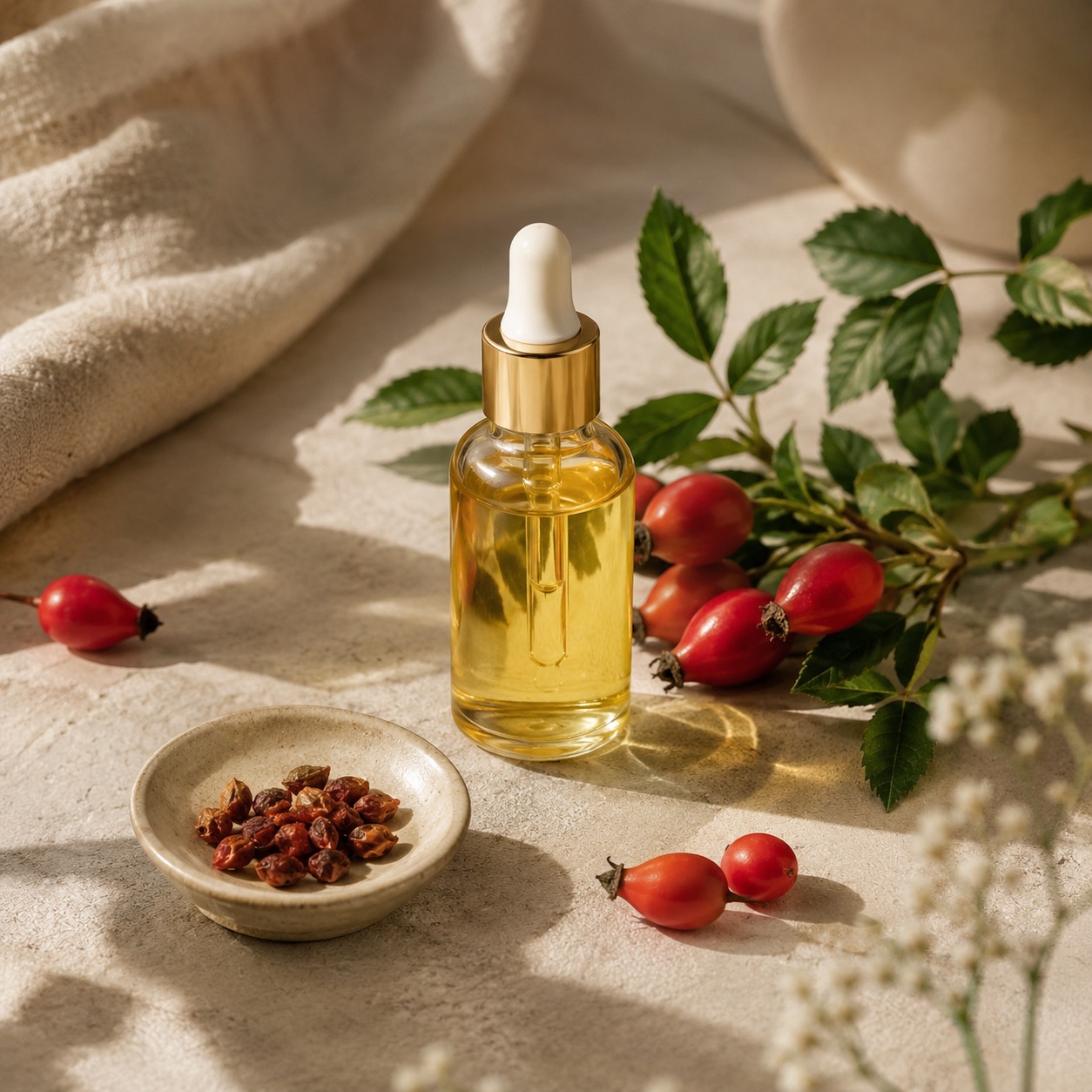
Lipid replenishment is the practice of providing the skin with the specific fatty acids and oils that the barrier has lost. These typically include linoleic acid, oleic acid, vitamin E, and plant-derived squalene, delivered through oils like sunflower, sweet almond, jojoba, argan, rosehip, raspberry seed, and pumpkin seed.
Aggressive body exfoliation can deplete an already thinning barrier and worsen menopausal dryness and sensitivity. Gentle methods used sparingly are usually fine. Daily scrubs, frequent acid use, or rough exfoliating mitts often cause more problems than they solve on mature body skin.
Because menopausal dullness is usually caused by lipid loss rather than surface buildup. Removing more cells from an already thinned barrier tends to make the dullness worse over time. Replenishing the lipids that the barrier is missing addresses the actual cause.
Yes, particularly after 45. Over-exfoliation thins the barrier, increases water loss, and produces a cycle of tightness, sensitivity, and reactive skin. Many women find their skin improves substantially within weeks of simply doing less and replenishing more.
There is no universal rule, but for most women in this phase, less is more. Once a week, or even less, with a gentle method, is usually plenty. The skin signals when exfoliation is helping (smooth, comfortable, calm) and when it is not (tight, stinging, reactive). The signals are worth listening to.
More from The Baya Journal