Skin Science · 8 min read
Why Jojoba Oil Feels Lightweight Yet Nourishing
The biology behind jojoba's unusual combination of lightweight feel and deep nourishment, and why its sebum-like structure makes it ideal for mature skin.
Three things to know
What Jojoba Actually Is.
Why It Feels Lightweight.
Why It Nourishes Despite the Light Feel.
Most plant oils make you choose. A rich oil nourishes deeply but leaves a heavy residue. A light oil absorbs quickly but feels insubstantial on the skin. The lightweight-and-nourishing combination is unusual enough that women trying jojoba for the first time often comment on it specifically. The oil feels like nothing, and yet the skin feels soft for hours.
There is a specific biological reason for this, and it is unlike any other plant oil in skincare.
Jojoba is not technically an oil. It is a liquid wax ester, and its molecular structure is more similar to human sebum than to any other plant-derived ingredient. That single fact explains almost everything about how it feels and what it does for the skin.
What Jojoba Actually Is
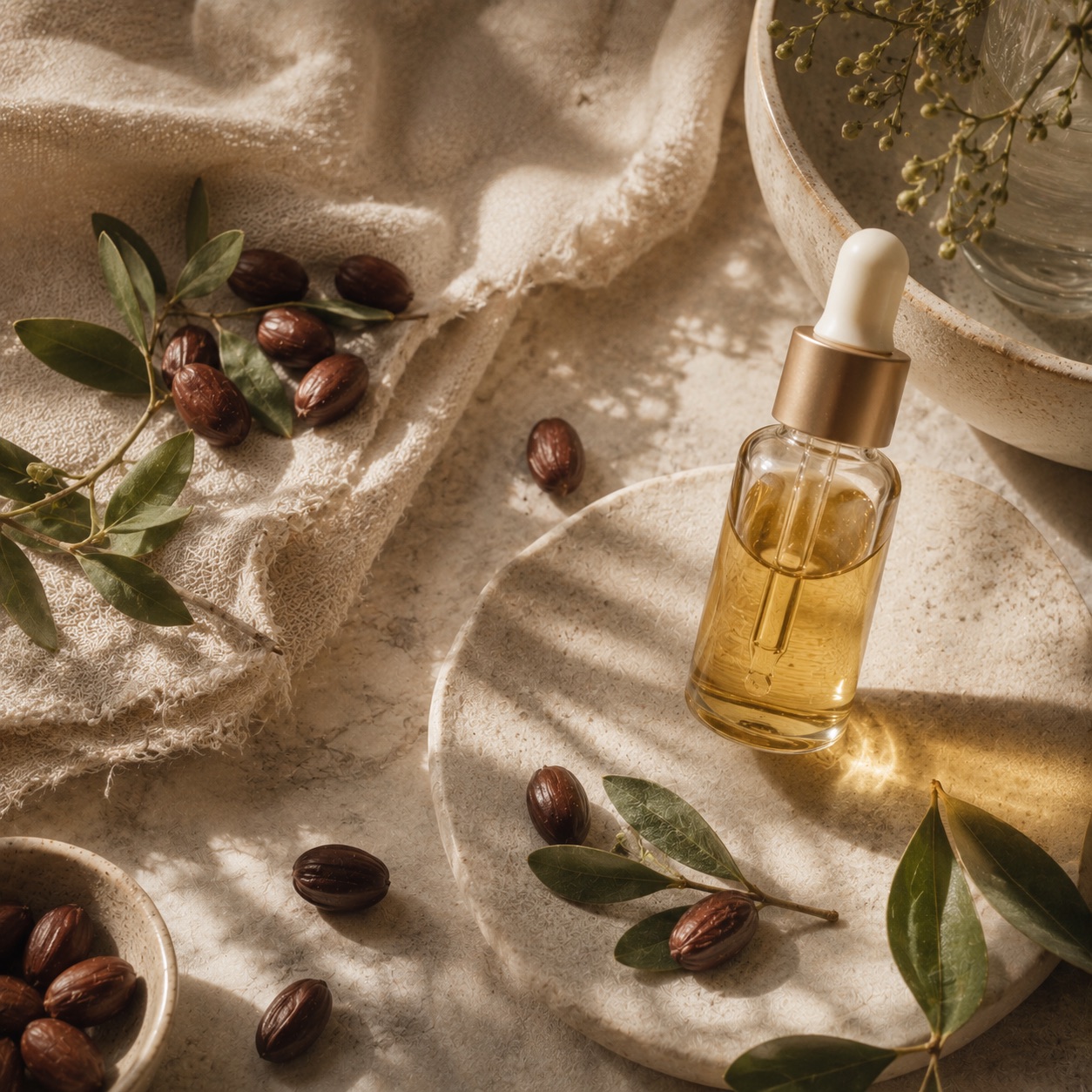
Jojoba (pronounced ho-HO-ba) is pressed from the seeds of Simmondsia chinensis, a shrub native to the Sonoran Desert across northern Mexico and the southwestern United States. The plant is unusual in many ways. It can live for over a hundred years. It thrives in conditions that would kill most other crops. It produces seeds that contain roughly 50% of their weight in liquid wax.
The liquid pressed from those seeds looks like an oil and behaves like an oil in most practical respects. But chemically, it is something different. Most plant oils are triglycerides, three fatty acids attached to a glycerol backbone. Jojoba is a wax ester, a long-chain fatty acid attached to a long-chain fatty alcohol. This distinction matters because wax esters behave differently on skin than triglycerides do.
The molecular structure determines almost everything that follows.
Why It Feels Lightweight
The wax ester structure makes jojoba absorb differently than other plant oils.
Triglyceride oils sit on the skin briefly before being broken down by enzymes in the barrier. Heavier triglycerides leave a noticeable surface film. Lighter ones absorb faster but can still feel oily for a few minutes after application.
Wax esters interact with the skin differently. They are recognized by the skin as similar to its own surface lipids, integrate quickly into the existing lipid film, and leave very little surface residue. The skin feels softened without feeling coated.
This is why jojoba is one of the few plant-derived ingredients that works well even on people who normally dislike the feel of facial oils. It absorbs cleanly. It does not pool in fine lines or feel greasy an hour later. It simply leaves the skin softer and more comfortable.
Why It Nourishes Despite the Light Feel
The lightweight sensation could easily be mistaken for surface conditioning that does not penetrate or deliver benefits. With jojoba, that is not what is happening.
Jojoba's wax ester structure is remarkably similar to the wax esters in human sebum. Human sebum is roughly 25% wax esters. Jojoba is essentially pure wax ester. When jojoba reaches the skin, it integrates into the barrier's existing lipid film rather than sitting on top of it. The skin recognizes it as compatible material.
This integration is what produces the nourishing effect:
- The barrier gains additional surface lipids that closely match its own
- Transepidermal water loss decreases because the surface film is more complete
- The skin can use jojoba's structure to support its own barrier function
- Inflammation tends to reduce because the barrier is more intact
The lightweight feel is real, and so is the nourishment. They are not opposites. The same molecular structure produces both.
The Sebum Connection
The relationship between jojoba and sebum deserves more attention than it usually receives.
Human sebum is the natural oil the skin produces from sebaceous glands. It is a mixture of triglycerides, wax esters, squalene, free fatty acids, and cholesterol. The wax esters in sebum serve several functions: they help form the protective surface film, they slow water loss, they contribute to the skin's slight acidity, and they help maintain barrier integrity.
In menopause, sebum production declines significantly. The wax esters that helped maintain the surface film become less abundant. The skin loses some of the natural protection that sebum provided for decades.
Jojoba's molecular similarity to sebum's wax esters makes it unusually well-suited to fill this specific deficit. It is not just adding lipids; it is adding lipids that closely match what the skin produced naturally and is now producing less of.
For mature skin, this is one of the more biologically intelligent matches available.
Why It Works for So Many Skin Types
Jojoba's compatibility with skin makes it tolerated across a wide range of skin types and conditions.
Dry skin responds to jojoba because it adds the surface lipids the barrier needs.
Mature skin benefits from the sebum-like wax esters that replace what aging has reduced.
Sensitive skin tolerates jojoba well because the barrier recognizes it as compatible material rather than reacting to it.
Oily and combination skin can use jojoba because the wax esters can actually signal to sebaceous glands to slow production. The skin senses adequate surface lipids and reduces its own output, often producing less congestion rather than more.
Acne-prone skin generally tolerates jojoba better than most other plant oils. It is non-comedogenic for most people and rarely causes the breakouts that heavier oils can trigger.
This unusual range of compatibility is part of why jojoba has remained a staple in serious skincare across decades, while trendier oils come and go.
Stability and Shelf Life
A practical advantage worth knowing. Jojoba is one of the most stable plant-derived skincare ingredients available.
Most plant oils contain polyunsaturated fatty acids that are vulnerable to oxidation. Oils high in linoleic acid (like rosehip and sunflower) deliver excellent barrier benefits but require care in formulation and storage because they can go rancid.
Jojoba is different. Because it is a wax ester rather than a triglyceride, and because its fatty alcohol component is highly stable, jojoba resists oxidation for years. It does not go rancid the way triglyceride oils do. A bottle of pure jojoba stored properly can remain stable for five years or more.
In a formulation, jojoba also helps stabilize the more delicate oils around it. Including jojoba in a blend with high-linoleic oils (sunflower, rosehip) extends the shelf life of the whole formula and protects the more vulnerable components.
This is part of why jojoba appears in so many well-designed botanical oil blends. It contributes its own benefits and protects the benefits of the other ingredients.
What the Research Supports
The evidence base for jojoba is broad and consistent across decades.
Barrier function. Multiple studies confirm that jojoba supports skin barrier integrity and reduces transepidermal water loss with consistent application.
Sebum balance. Research suggests jojoba can help regulate sebum production by signaling adequate surface lipids to sebaceous glands.
Anti-inflammatory activity. Jojoba has documented anti-inflammatory effects in skin tissue, which contributes to its tolerance even on reactive skin.
Wound healing support. Several studies show jojoba supports wound healing, likely through a combination of barrier support and anti-inflammatory effects.
Antimicrobial properties. Jojoba has shown activity against several common skin bacteria, which may contribute to its acceptable use on acne-prone skin.
This is a substantial list, and it is grounded in research that has accumulated quietly over many decades.
How Jojoba Works in Menopausal Skincare
For perimenopausal and menopausal skin specifically, jojoba addresses one of the more underdiscussed problems of this phase: sebum decline.
Most articles about menopausal skin focus on collagen loss, barrier depletion, and hydration. These are real and important. Sebum decline is less discussed but contributes meaningfully to the same symptoms. The reduction in surface lipids means the skin has less natural protection, and the protective film that sebum provided for decades becomes thinner.
Jojoba does not replace lost sebum chemically (sebum is more complex), but it provides the wax ester component of sebum directly. Applied consistently, it gives the skin's surface back some of what it has lost.
For body skin in particular, which produces less sebum than facial skin to begin with, jojoba's contribution is more noticeable. Areas like the shins, arms, and chest, which have always relied more on barrier lipids than on surface sebum, benefit from jojoba's specific properties.
Why Jojoba Works Best in Blends
Pure jojoba is a useful skincare ingredient on its own, but it works better in combination with other oils for one specific reason: jojoba does not deliver essential fatty acids.
Most of jojoba is wax ester, not triglyceride. This is what gives it its unique properties, but it also means it does not contribute meaningful amounts of linoleic acid or alpha-linolenic acid, the essential fatty acids the skin needs to produce ceramides and support barrier function.
A well-formulated blend pairs jojoba with oils that do contribute these fatty acids:
- Sunflower and rosehip provide linoleic acid
- Sweet almond and argan provide oleic acid and additional vitamin E
- Raspberry seed contributes alpha-linolenic acid
- Pumpkin seed adds mineral content and complementary antioxidants
In a blend, jojoba does three jobs at once: it provides sebum-like surface lipids, it stabilizes the more delicate oils, and it improves the sensory feel of the formulation. The other oils provide the fatty acid replenishment jojoba does not.
This is why a thoughtful blend tends to outperform jojoba used alone, and why jojoba is included in almost every serious botanical oil formulation.
The Baya Approach
Jojoba is part of the Baya blend specifically because it brings something the other oils cannot. The sebum-like wax esters, the lightweight feel, the stability it lends to the formula, and the surface film it contributes all add to what the rest of the oils are doing.
Combined with sunflower, sweet almond, argan, rosehip, raspberry, and pumpkin seed oils, jojoba provides the sensory and structural qualities that make the blend feel light on the skin while still delivering substantial barrier support.
The result is the rare body oil that absorbs cleanly without leaving residue, while still doing the deep replenishment menopausal skin actually needs.
The Bottom Line
Jojoba feels lightweight because it is a wax ester rather than a triglyceride, and the skin recognizes it as compatible with its own surface lipids. It nourishes despite the light feel because that same molecular structure integrates into the barrier and provides the wax esters the skin produces less of in menopause.
The combination of lightweight feel and meaningful barrier support is unusual among plant oils and reflects jojoba's biological similarity to human sebum. This makes it particularly valuable for mature skin, which has lost some of the sebum that maintained the surface film for decades.
Jojoba works best in blends, where it pairs with oils that deliver essential fatty acids it does not provide on its own. The combination tends to feel lighter and work better than any single oil applied alone.
Frequently asked questions
Correct. Jojoba is technically a liquid wax ester rather than a triglyceride oil. Its molecular structure is more similar to human sebum than to any other plant oil, which is why it behaves and feels differently than oils like olive, almond, or coconut.
Because its wax ester structure integrates with the skin's existing surface lipids rather than sitting on top of them. The skin recognizes it as similar to sebum and absorbs it cleanly without the residue heavier triglyceride oils leave behind.
Yes, particularly so. As sebum production declines with menopause, the skin loses some of the wax esters that maintained its surface film. Jojoba's structure closely matches those wax esters, making it one of the most biologically compatible ingredients for replacing what aging skin produces less of.
Jojoba is generally non-comedogenic and is considered safe for most skin types, including acne-prone skin. Because it resembles sebum, it can actually help signal sebaceous glands to slow excess oil production rather than triggering congestion.
It can, but it works better in a blend. Jojoba does not deliver essential fatty acids like linoleic acid, which the skin needs for ceramide production. Pairing jojoba with oils rich in essential fatty acids produces better results than using either alone.
Jojoba is one of the most stable skincare ingredients available. A properly stored bottle of pure jojoba can remain stable for five years or more, far longer than most plant oils. In formulations, jojoba also helps stabilize more delicate oils against oxidation.
More from The Baya Journal