Skin Science · 8 min read
The Most Overlooked Cause of Dry Menopausal Skin
The piece most menopausal routines are missing. Why barrier support, not richer lotion, is the answer to persistent dry skin after 45.
Three things to know
The Familiar Suspects.
The Overlooked Cause: Missing Barrier Support.
What Barrier Support Actually Means.
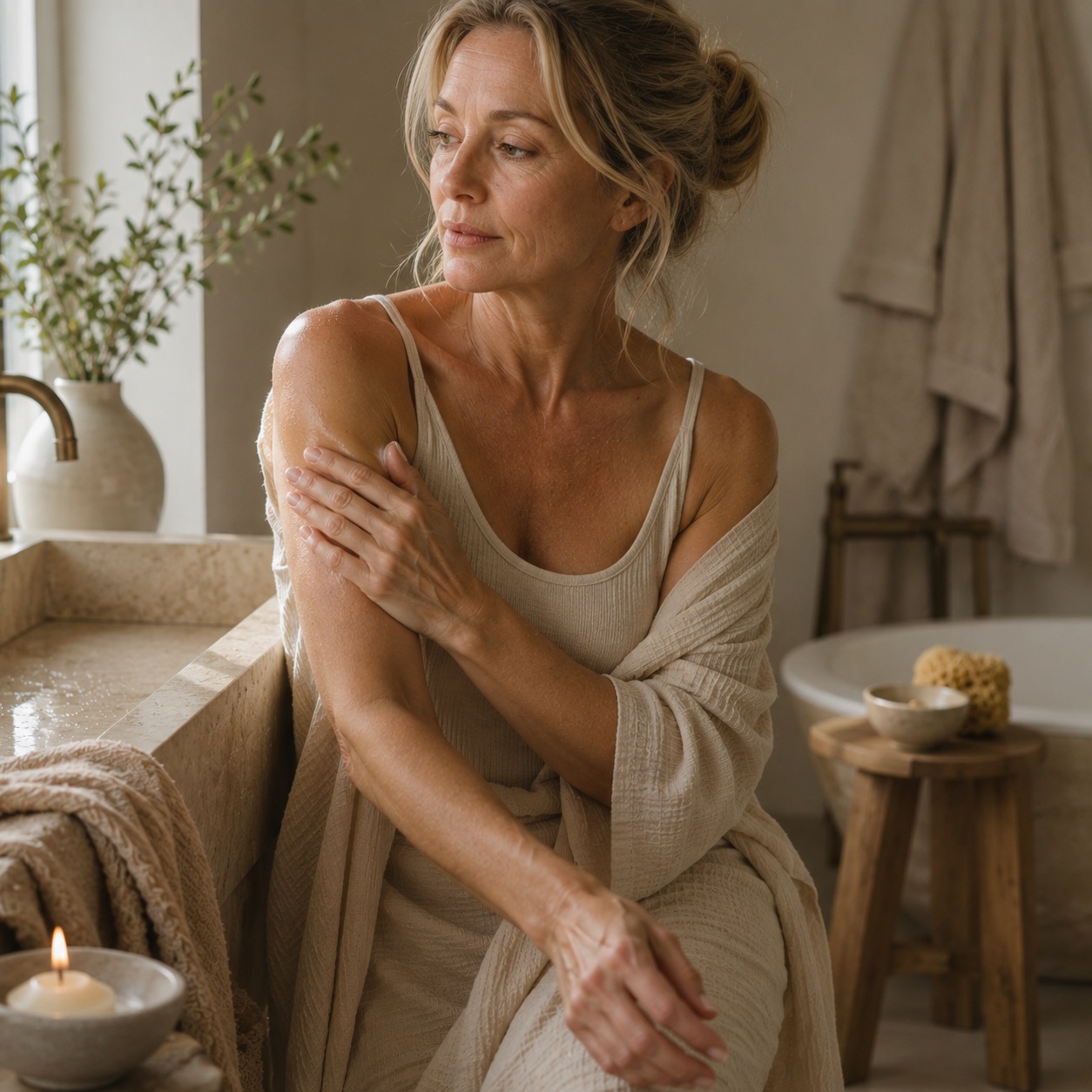
A woman in her early fifties stands at the bathroom mirror after a shower, applying body lotion as she has done for thirty years. Within twenty minutes, her shins feel tight again. Her forearms have that faint papery quality she has come to associate with menopause. She reaches for the bottle a second time, perhaps a third, and still her skin seems to drink the lotion without ever softening.
Most women in this situation reach a familiar conclusion. They need a richer cream, a thicker formula, perhaps something with hyaluronic acid or shea butter. So they search for a better lotion.
The lotion is rarely the problem. The category is.
The most overlooked cause of persistent dry skin in menopause is not a missing ingredient. It is a missing kind of support entirely. The skin's barrier has lost the lipids that hold it together, and no amount of water-based lotion, however luxurious, can rebuild what has been depleted. What menopausal skin is asking for is barrier support, delivered through a lipid-rich body oil designed to replenish what hormonal change has taken away.
Once this distinction is understood, the rest of the routine starts to fall into place.
The Familiar Suspects
When dry skin appears in the late forties or fifties, the usual explanations come quickly.
Hormones. Estrogen decline reduces sebum, lowers ceramide production, and slows the skin's natural moisture retention. This is true and important.
Aging. The skin thins with time, repairs more slowly, and produces less of nearly everything it once did.
Environment. Dry indoor air, hot showers, low winter humidity, all of these contribute.
These factors are real. They get discussed in articles, on podcasts, in conversations with friends comparing notes on menopause. Most women understand them, at least in outline.
But there is a fourth piece, sitting quietly outside the usual conversation, that explains why so many thorough moisturising routines still leave the skin feeling dry. It is not about the hormones or the weather. It is about the kind of product the skin is being asked to recover with.
The Overlooked Cause: Missing Barrier Support
The skin's barrier is built from specific materials. Ceramides. Cholesterol. Free fatty acids. Together they form what is sometimes described as a brick wall, with skin cells as the bricks and lipids as the mortar between them. This structure is what holds water inside the skin and keeps irritants out.
In menopause, the mortar thins. Estrogen used to support its production. As estrogen declines, the lipids deplete. Gaps open between cells. Water that should stay inside the deeper layers begins to evaporate faster than it should. The skin becomes dry not because something is sitting on top of it, but because something is missing from inside it.
This is the part most routines do not address.
A typical body lotion is around 70 to 90 percent water, with humectants like glycerin and a small percentage of emollient oils. It is designed to deliver moisture to the surface of the skin and let an intact barrier hold it in. On the skin you had at 30, this approach worked perfectly.
On menopausal skin, the same lotion behaves differently. The water absorbs and then evaporates through the thinned barrier almost as quickly as it goes on. The humectants, in dry environments, can sometimes pull moisture upward from the deeper layers rather than drawing it in from the air. The oil content is usually too low to genuinely replenish the lipid mortar the barrier needs.
You can feel this in real time. The lotion feels pleasant. Twenty minutes later the skin is tight again.
The problem is not the lotion's quality. It is that the category was never designed to rebuild a depleted barrier. That requires something else.
What Barrier Support Actually Means
Barrier support is the practice of delivering the specific lipids the skin has lost, in forms the barrier can recognize and use.
This means fatty acids that match the ones the skin produces naturally. Linoleic acid, the building block of acylceramides that hold the barrier together. Oleic acid, which softens and conditions. Alpha-linolenic acid, the omega-3 that supports skin calmness. Vitamin E, the natural antioxidant that protects skin lipids from oxidation. Plant-derived squalene, similar to the squalene the skin produces in its own sebum.
These compounds are not exotic. They are the materials the skin's barrier was always built from. The challenge in menopause is that the body produces them in smaller amounts, while daily wear continues to deplete them at roughly the same rate as before.
A well-formulated body oil delivers these materials in concentrated form, without the water phase that evaporates so quickly. Applied to damp skin, the lipids slot into the gaps in the barrier and begin the slow work of restoring its structure. The skin softens not because something has been added on top of it, but because something has been replenished within it.
This is the kind of work no water-based lotion can do, regardless of how rich or expensive.
Why This Cause Is So Often Missed
There are a few reasons barrier support gets overlooked.
The lotion habit is cultural. Most women in midlife grew up with body lotion. The category is familiar, the format is convenient, and the cultural association between "moisturising" and "lotion" is deep. Body oils, by comparison, can feel like a new and slightly unfamiliar category, even though they have been used for centuries in many cultures.
Oils carry an outdated reputation. Older generations associated facial and body oils with heaviness, greasiness, and pore congestion. Modern cold-pressed plant oils, when chosen carefully and applied correctly, are nothing like the heavy mineral oils of earlier decades. But the reputation lingers.
Marketing focuses on adding water. The skincare industry is in the middle of a long humectant moment. Hyaluronic acid, glycerin, and other water-attracting ingredients are featured prominently. These ingredients are genuinely useful, but on a barrier that cannot hold water, they cannot do their job alone.
The conversation in beauty media skews younger. Most skincare content is aimed at women in their twenties and thirties, whose skin is well-suited to water-based formulations. The category-level shift that menopausal skin benefits from rarely makes it into mainstream coverage.
So women in their forties and fifties keep doing what worked at 30, reaching for richer lotions when the issue is not richness but composition. They are looking for a better lotion when the skin is asking for a different category entirely.
Signs That Barrier Support Is What Your Skin Is Missing
A few signals suggest that the gap in the routine is barrier-shaped:
- Lotion feels good on but the skin is tight again within an hour
- Skin seems to "drink up" moisturiser without softening
- Shins, hands, and chest remain persistently dry despite consistent care
- The skin feels papery or fine to the touch rather than supple
- Reactivity has increased, with products that used to feel fine now occasionally stinging
- Itchiness in the legs at night, especially in winter
These are the classic signs of a depleted barrier asking for the materials it has lost, rather than for more water it cannot hold.
What Menopausal Skin Responds To
The most effective body oils for menopausal skin are those built around fatty acid profiles that match the skin's own.
A few of the oils that consistently support mature barriers:
- Sunflower seed oil, particularly high in linoleic acid, which is essential for ceramide production
- Sweet almond oil, gentle and rich in oleic acid and vitamin E
- Jojoba, technically a wax ester, structurally similar to the skin's own sebum
- Argan, balanced in fatty acids with naturally occurring vitamin E
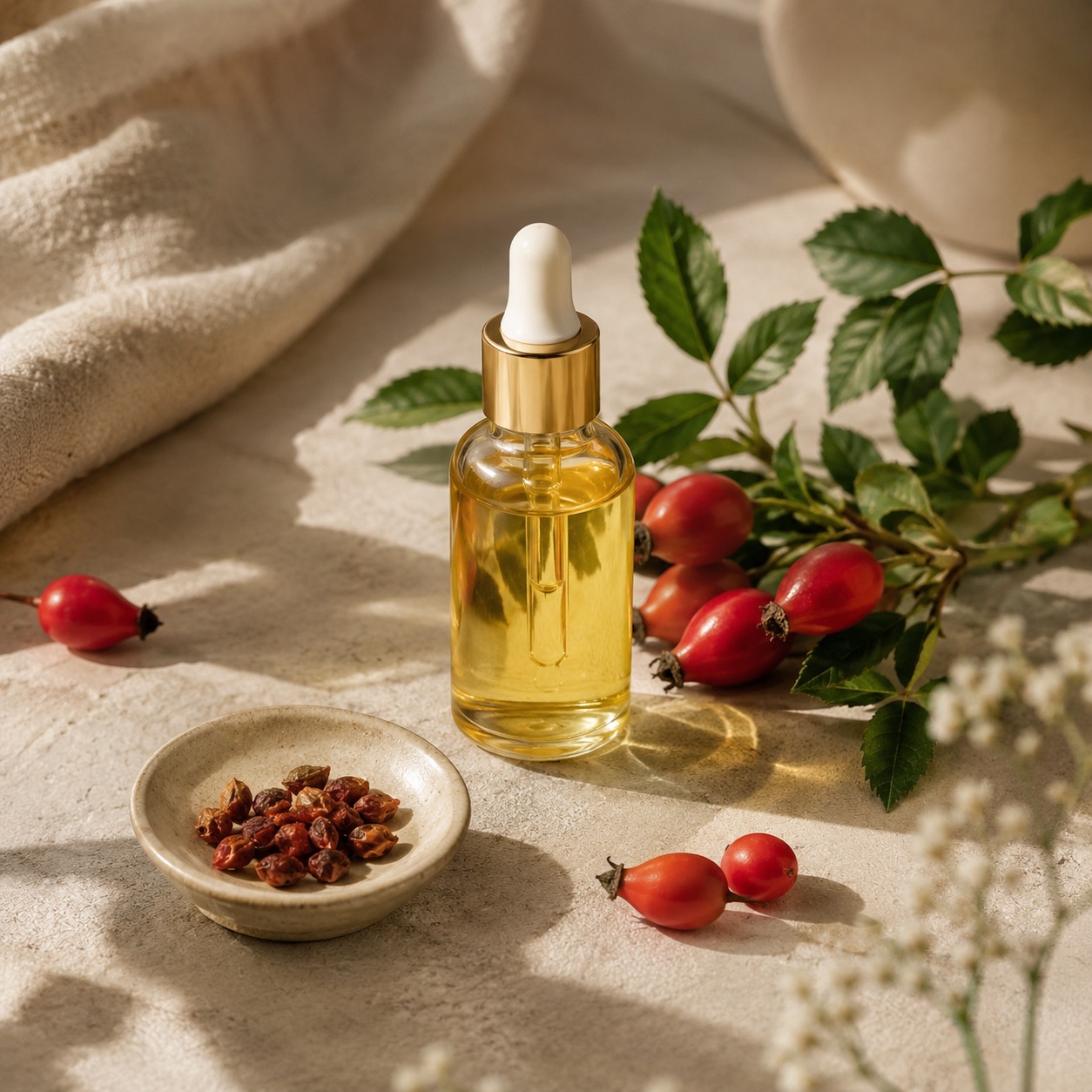
- Rosehip seed oil, exceptionally rich in linoleic acid and alpha-linolenic acid
- Raspberry seed oil, contributing omega-3 fatty acids and antioxidants
- Pumpkin seed oil, rich in zinc, magnesium, and a calming fatty acid profile
These oils are typically combined rather than used in isolation. The blend matters. Each oil brings something the others do not, and the proportions determine how well the formula matches what menopausal skin specifically needs.
How to Use Body Oil for Barrier Support
The single most important habit is timing.
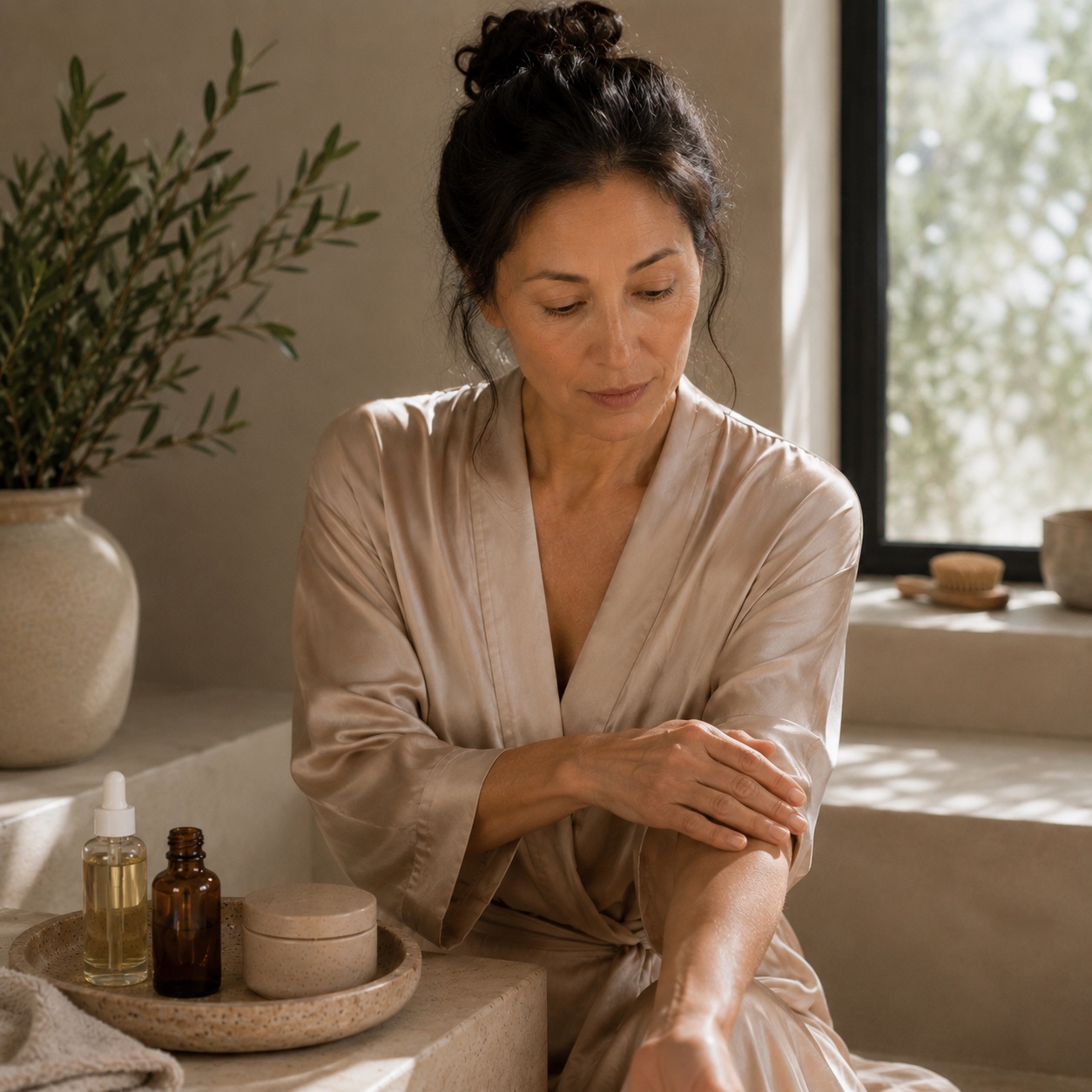
Apply the body oil to damp skin within a few minutes of stepping out of a warm shower or bath. Pat the skin gently rather than rubbing it dry, leaving a faint film of moisture. The oil locks that moisture in while delivering its lipids directly to the open, receptive barrier.
Consistency does the rest. Daily application, particularly in colder months. Paying attention to the chest, hands, shins, and elbows, which often show menopausal changes first. Patience over weeks rather than days, because the barrier rebuilds slowly and the most striking improvements tend to appear between four and twelve weeks of steady use.
This is not a heroic routine. It is a gentle, repeatable one. Its power is cumulative.
The Baya Approach
Baya was built around this specific insight. That women in perimenopause and menopause have been working with the wrong category of product, not because they have done anything wrong, but because the dominant skincare culture has not caught up to the biological reality of their skin.
Baya Replenishing Body Oil delivers the lipids the menopausal barrier has lost, in proportions chosen for biological compatibility. Sunflower, sweet almond, jojoba, argan, rosehip, raspberry, and pumpkin seed oils work together to restore the specific fatty acids the barrier needs to rebuild itself.
The aim is not to compete with lotion as a slightly different version of the same thing. The aim is to do something lotion was never designed to do.
The Bottom Line
If your skin has felt persistently dry through menopause despite diligent moisturising, the missing piece is almost certainly not a richer cream. It is a different category of support entirely.
Menopausal skin has lost specific lipids that water-based lotions cannot replenish. The barrier needs fatty acids, antioxidants, and the kind of plant-oil-based replenishment that delivers these compounds directly to the depleted mortar between skin cells. Body oil does this. Lotion cannot.
The most overlooked cause of dry menopausal skin is the absence of barrier support in routines that otherwise look thorough. The fix is straightforward: replace or supplement the lotion with a well-formulated body oil, apply it to damp skin daily, and give it the few weeks it needs to do its work.
The improvement, when it arrives, tends to be lasting. The skin that has felt dry for years can become comfortable again, often within a season, once it is given what it has been asking for all along.
Frequently asked questions
Barrier support is the practice of replenishing the specific lipids, fatty acids, and antioxidants that the skin's outer barrier is built from. For menopausal skin, this usually means lipid-rich plant oils that deliver compounds like linoleic acid, oleic acid, and vitamin E, which the barrier needs to retain water and resist irritation.
Most body lotions are water-based and rely on an intact skin barrier to hold their moisture in. Menopausal skin has a thinner, less continuous barrier, so the water evaporates faster than the lotion can deliver it. The result is skin that feels tight again shortly after applying. Switching to a lipid-rich body oil addresses the underlying barrier loss rather than the surface symptom.
For most women in perimenopause and menopause, yes. Body oils deliver concentrated lipids without a water phase that evaporates quickly, which makes them more effective at replenishing what menopausal skin has specifically lost. Lotions still have a role for some women, but oils address the root cause of barrier dryness more directly.
A well-formulated blend with high linoleic acid content tends to work best. Look for cold-pressed oils such as sunflower, sweet almond, jojoba, argan, rosehip, raspberry seed, and pumpkin seed, ideally combined rather than used singly. The combination delivers a fuller fatty acid profile and better stability than any one oil alone.
Most women notice softer, less reactive skin within two to four weeks of consistent body oil use. More substantial improvements in texture, tone, and the resolution of chronic dryness typically appear between four and twelve weeks. The skin rebuilds gradually but reliably with daily care.
Yes. For many women in menopause, replacing the lotion entirely with a lipid-rich body oil applied to damp skin produces better results than using lotion alone. Some women prefer to use both, with oil applied first to damp skin and a light lotion layered afterward if desired.
More from The Baya Journal